i.Context
Agents that know what you're building
Every agent reads from one shared model: the research, the specs, the codebase, the production signals. No re-briefing. No context loss between stages. The work compounds instead of resetting.
Intent, planning, code, verification, execution, and audit, under one governed runtime. Speeding up a single phase doesn't make the system faster; marshalling the whole does. No context leakage between handoffs. No coordination tax between tools. Engineers ship with leverage. Leaders ship with proof.
Every agent reads from one shared model: the research, the specs, the codebase, the production signals. No re-briefing. No context loss between stages. The work compounds instead of resetting.
Set the guardrails once — the conventions to follow, the tests every change must pass, the budget a run can spend — and every build runs inside them. You steer. Agents execute.
Research, design, build, tracking, operations — five modes, one data model, one audit trail. The work flows through; nothing gets dropped at the seams.
The research doc never makes it into the Figma frame. The Figma frame never quite matches the spec. The spec drifts from the implementation. The production alert can't be traced back to the design decision that caused it.
Every handoff is a place where context evaporates, intent gets re-interpreted, and the why gets lost.
Now multiply that by every agent your team adds. Each one starts cold, asks for the same context again, and produces work the next stage has to re-translate.
Majordomo replaces the handoffs with one continuous flow. A research insight in Library becomes a brief in Studio. A Studio spec drives a Factory pipeline. A signal in Pulse links back to the brief that started it.
Same data model. Same audit trail. Same context, all the way through.
Agents don't restart at every stage. Neither does your team.
The handoffs are the bug. Majordomo is the fix.
Library, Studio, Factory, Tasks, and Pulse cover every phase from intent to audit — five modes most teams stitch together from five (or seven) separate tools, with team channels running alongside them. Each shares one data model with the next, so work moves forward instead of starting over, and every step stays traceable.
Sources, briefs, evidence
Specs, roadmap, OKRs
Runs, sandboxes, provenance
The work in flight
Signals, feedback, audit
Every artifact traceable to every other.
Below: what each mode does, what it produces, and how it hands off to the next inside the same governed runtime — no translation, no re-briefing, no losing the why.
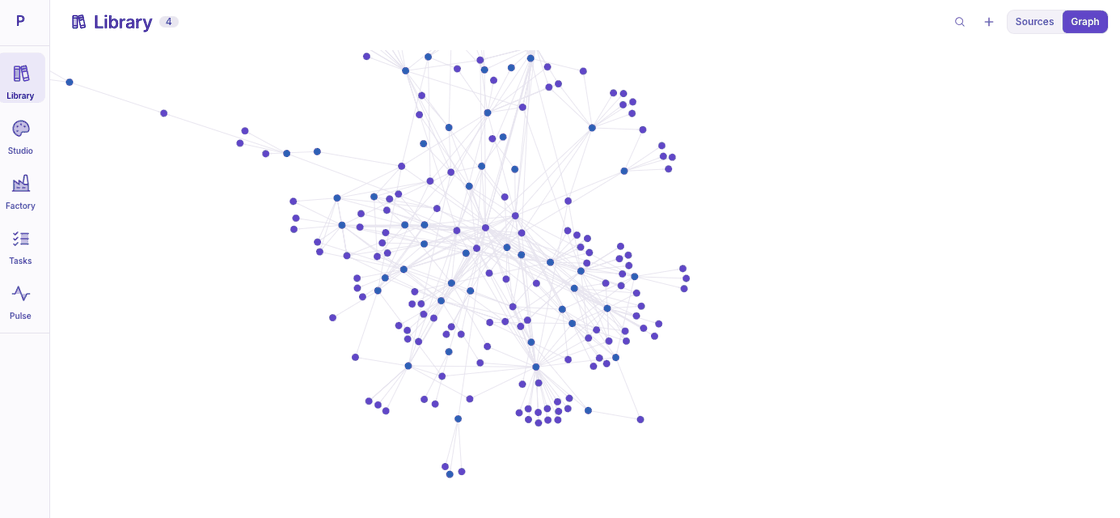
Bring your sources into one place — docs, notes, prior research. Library indexes them, surfaces the connections as a searchable, fully-cited graph, and keeps that context in the same workspace as the specs and roadmap it informs — so nothing has to be re-explained.
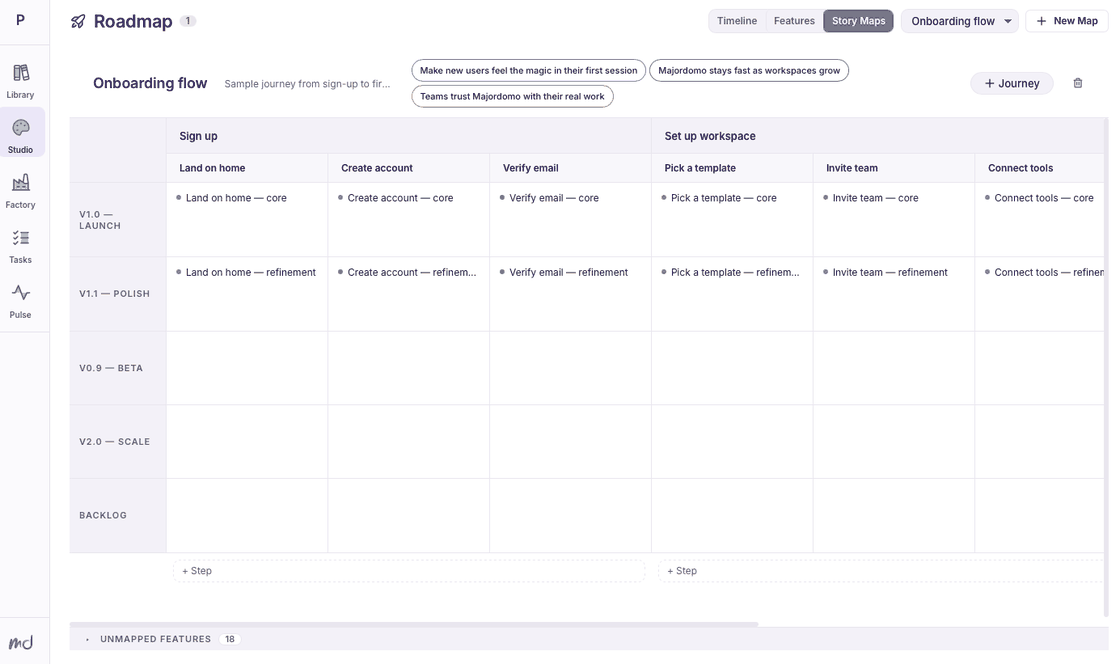
Studio is where intent gets specific, in two halves: Product — roadmap, story maps, and OKRs — and Feature — a searchable spec editor and visual design. It shares one workspace with Library and Factory — no re-creation, no translation. The output is a spec Factory can build from and a roadmap your team can ship against.
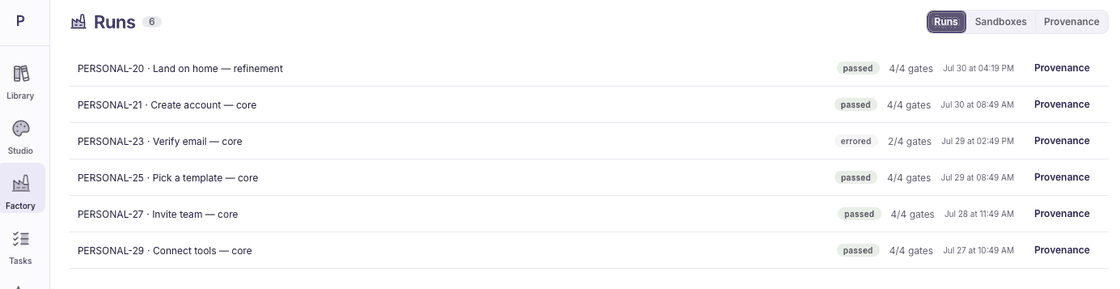
Factory turns a Studio spec, written requirements, or an existing codebase into a reviewed pull request. It runs the coding agent inside a clone of your repo, verifies against tests, and retries intelligently when a gate fails — same source of truth, no re-interpretation, every run recorded and inspectable.
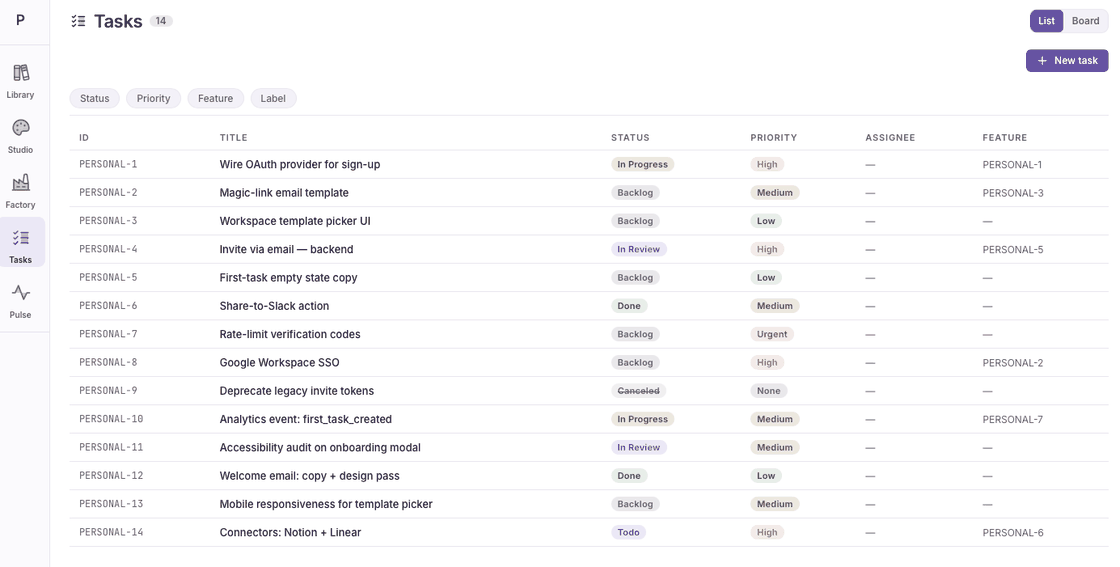
Tasks is the ledger between a spec and a shipped change. Each one carries a public id, an owner, and a line back to the feature it delivers — so a question about any piece of work has an answer, not an archaeology project.
The moment you ship, the feedback starts coming in. Pulse brings feedback, observations, AI-spend anomalies, and the access trail into one place — and turns the ones that matter into tracked work, so the next cycle starts from evidence instead of a blank page. The loop closes here.
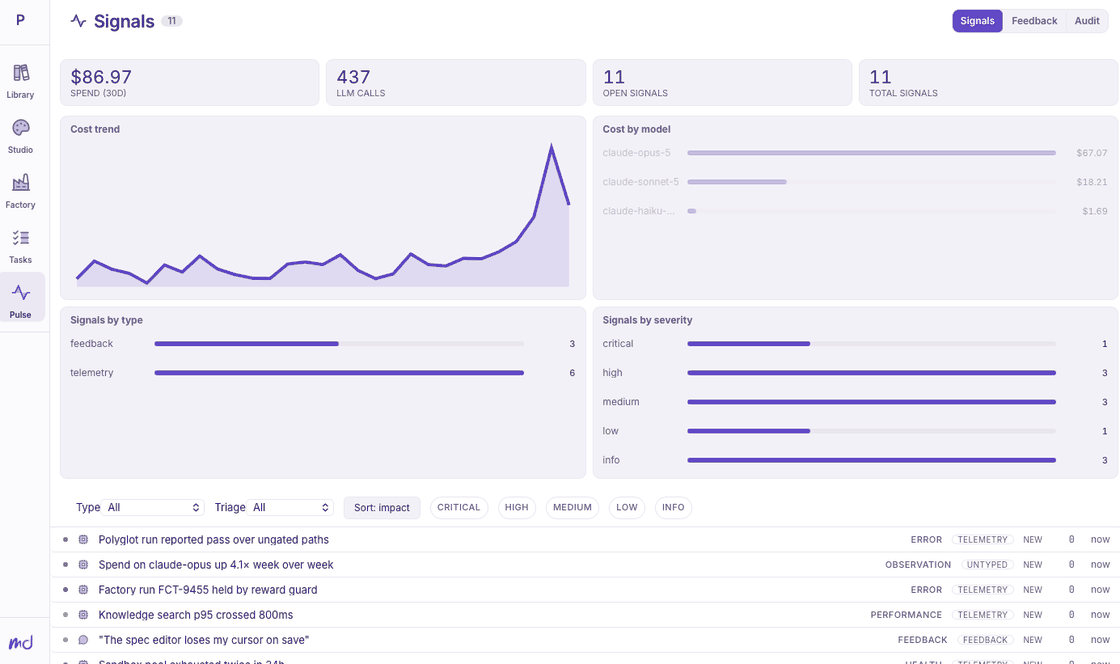
Because every artifact in Majordomo lives under one data model, the links are already there — a shipped feature to the Factory run that produced it, the Studio spec it implemented, and the Pulse signal that prompted it. The trail exists by construction, not by reconstruction after the fact.
For your auditors, your board, and the engineer who joined last week.
A build passed a gate it never ran.
Shipped to main. Every subsequent run inherits the fence — and the signal that started it stays attached to the change that closed it.
Reward guard unioned in the hardened diff-path parser: git C-style-quoted headers were invisible to every PROTECTED rule, so one accented character in a filename bypassed the guard entirely.
The bug the guard was built to catch was hiding in the guard itself.
A run may only report pass over paths its recipe can actually verify. Paths outside gate coverage are fenced: the run stops and asks, rather than scoring itself green.
Polyglot runs are reporting pass on diffs the recipe has no gate for. A run that touches code it cannot verify is being scored as a success — the number is green and it means nothing.
Filed from run telemetry, not a bug report. Nobody had to notice it by hand.
Every hop is a real record, linked at write time — not a report assembled afterwards.
Three changes that really shipped in Majordomo’s own repository — pull request, commit, and diffstat are as merged.
Roll out Majordomo across your organization with the provenance, cost controls, and support your teams — and your auditors — need.
Every artifact shares one data model, so the links between a shipped feature, the run that built it, the spec it implemented, and the signal that prompted it are there by construction.
Every change to every artifact is recorded — who, what, and when — in an append-only log that can't be silently rewritten. The audit trail is a property of the system, not a report you assemble later.
Real-time spend visibility per workspace, and a hard token-and-time budget enforced on every build run. Stop AI costs from being a quarterly surprise.
No build reaches a pull request without passing its tests and clearing a review gate — and a reward-guard holds suspicious green runs for a second look.
Every workspace is isolated — only the people you invite see its research, specs, builds, and signals. SSO and role-based permissions are on the roadmap.
Priority onboarding, custom integrations, and a direct line to the engineering team.